

The end of Peruvian coastal El Niño? It becomes moderate and could weaken more
(December 19, 2023) The summer began in Peru and many recent changes in the oceanic and atmospheric conditions in the Equatorial Pacific Ocean have altered national and international forecasts of the publicized El Niño event along Peruvian Coast, some of them apocalyptic and alarmist, others inaccurate because they gather imprecise data to turn them into the worst messages and report them as probable, when at present they are improbable.
In this sense, Peru Pesquero and his scientific advisor (Dr. Luis Icochea) sustained since July that the coastal El Niño event will not be a strong event. In the Niño 1+2 area (adjacent to the coast of Peru), during the last two weeks before Christmas-2023, has been observed that the Sea Surface Temperature anomalies suffered a drop in the 1+2 area, fluctuating the value between 1.3°C and 1.5°C, which it is classified as event of moderate magnitude. In other words, the possible catastrophic El Niño became weaker, leaving the climate alarmists without a floor.
In addition, taking into account the index officially used by the Multisectoral Committee for the Study of the El Niño Phenomenon (ENFEN) for the monitoring of El Niño, we have that this natural event is currently presented as moderate (very close to being considered as weak with anomalies values less than 1°C) because SST anomaly became less than 1.5°C during December 2023.
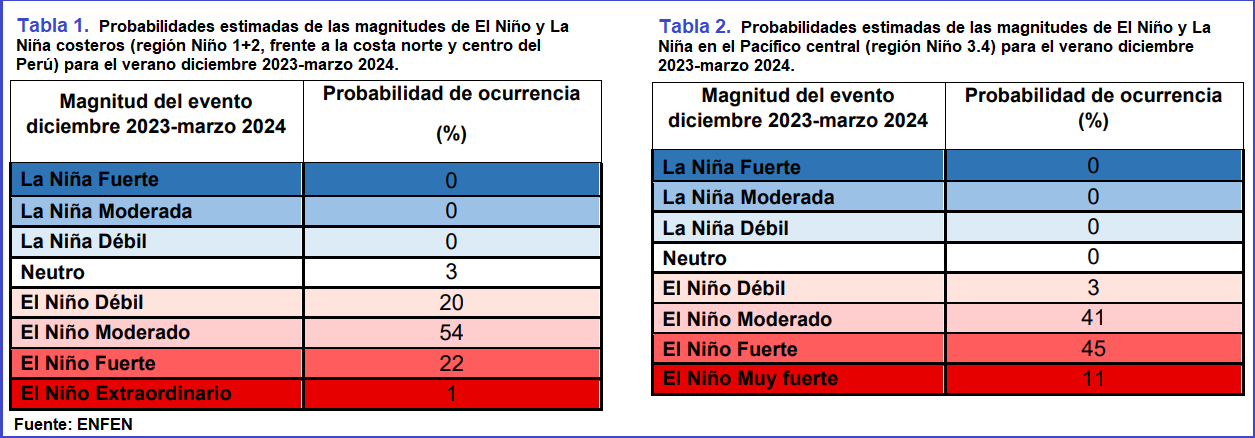
To ratify what was commented above, on December 15, ENFEN issued its latest communiqué (No. 20) where, based on the data observed, as well as the forecasts of international climate models to date, it reported that in the Niño 1+2 region, moderate warm conditions are more likely to predominate until February 2024, with a moderate magnitude (54%) and the probability of become a weak event (20%).
Likewise, with respect to the central Pacific (Niño 3.4 region), ENFEN expects El Niño to continue until early autumn 2024, reaching its maximum intensity between December and January. The most probable magnitudes for the summer are strong (45%) and moderate (41%). It should be noted that this area is not connected to the Peruvian coast.
Undoubtedly, the ENFEN’s message can generate an emotional impact rather than a scientific probability and, after analyzing its analysis on the fishing resources, in this case, it assures that the mackerel will increase its reproductive process according to its historical pattern, so why did the Ministry of Production close the capture operations of this pelagic fish (mackerel that many times accompanies the jack mackerel)?
Likewise, hake (demersal) which, according to ENFEN, will continue to have a low availability for industrial catches in the coming weeks, like what was observed during November. At this point, it is appropriate to refute, because this species, being subject to the El Niño impact, expands its area of distribution towards the south, a clear example was what happened in the extreme event of 1997-1998, where the industrial hake fleet had to move to Salaverry (more than 200 miles south of Paita). Currently, the largest specimens of this resource are located from Paita to the north.
Undoubtedly, offering less accurate information causes uncertainty in society, tourists and investors, especially if predictions of horrible scenarios are used to traumatize the population in the hope that a policy against the impacts of these natural events can be adopted.
Question: Until now: How much is the Peruvian government spending on prevention, communication and mitigation actions to face El Niño event? Let us hope that inversions accountability will be transparent.
Publicaciones Relacionadas
- en: Noticias
- Publicado por: perupesquero
- en: Noticias
- Publicado por: perupesquero
- en: Noticias
- Publicado por: perupesquero
Dejar Comentarios